
Key takeaways
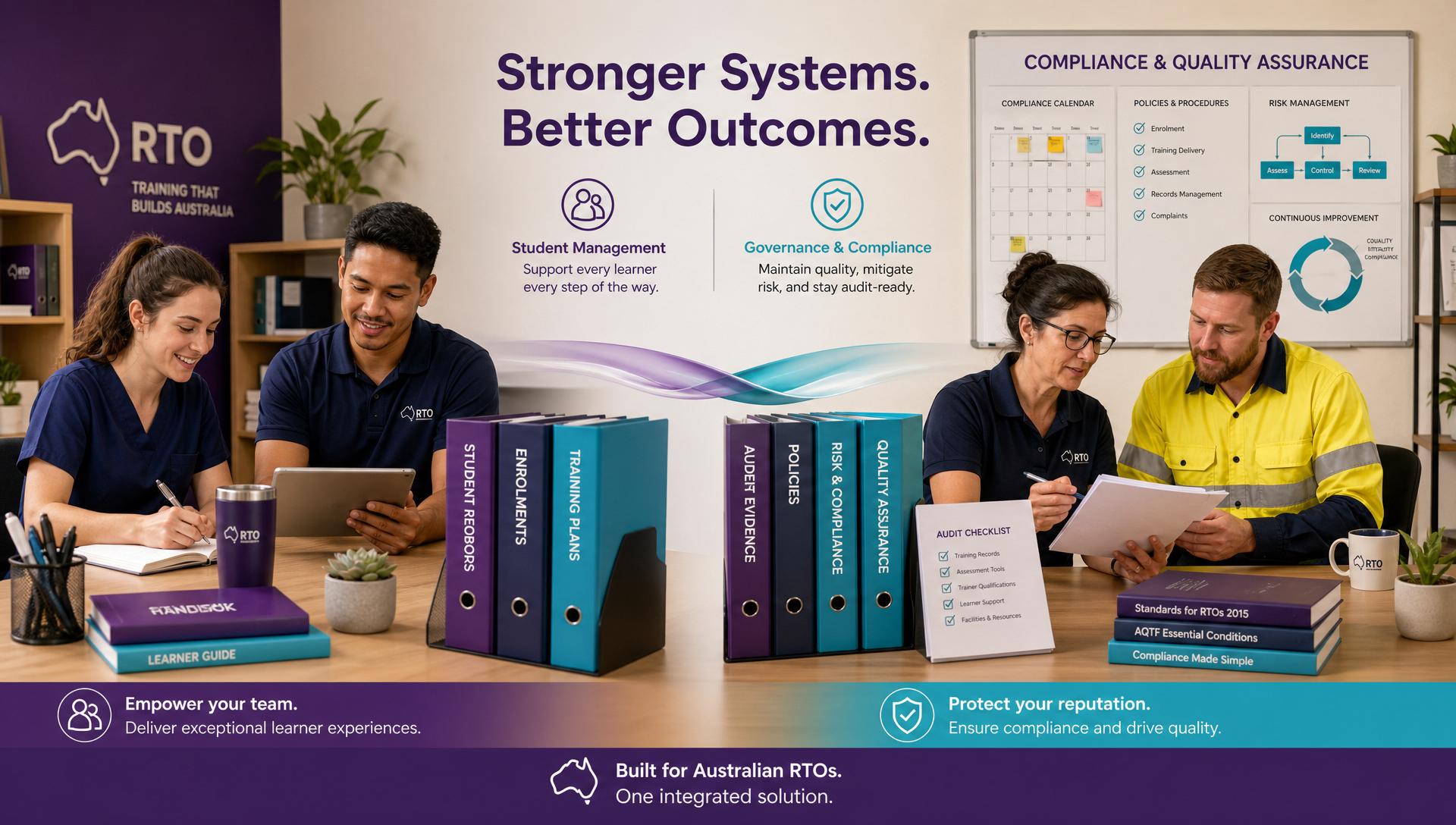
- 1A Student Management System (SMS) runs the student lifecycle — enrolments, AVETMISS, USI, certificates and funding — while governance, trainer currency, TAS reviews, validation and continuous improvement need their own connected evidence workflows.
- 2The 2025 Standards for RTOs shifted the audit question from 'do you have a policy?' to 'can you demonstrate the outcome?' — making it important to test how your current tools demonstrate outcomes in practice.
- 3A dedicated compliance layer manages obligations mapped to each clause, live Governance/Risk/CI registers, a trainer matrix, TAS workflows, validation scheduling and one-click audit packs.
- 4The right 2026 operating model is SMS for administration and delivery, plus a compliance platform for self-assurance and audit readiness — with responsibilities and evidence flows clearly defined.
- 5ComplyHub is designed as the compliance layer and integrates with aXcelerate, VETtrak and PowerPro via API/CSV so operational admin stays in your SMS while evidence and accountability become visible and defensible.
In summary
A Student Management System (SMS) like Wisenet, VETtrak, aXcelerate, PowerPro or ReadyTech runs your student lifecycle — enrolments, AVETMISS reporting, USI validation, certificates and funding — while governance, trainer currency, TAS, validation and improvement require evidence beyond a student record. Some SMS products provide additional compliance features; test your actual setup against those workflows.
RTO compliance software (a "compliance layer") sits alongside your SMS and manages the obligations an SMS leaves in spreadsheets and inboxes: evidence mapped to each clause, live Governance/Risk/CI registers, a trainer matrix, TAS workflows, validation scheduling and one-click audit packs.
The smart operating model for 2026 is not one tool pretending to do everything — it's an SMS for administration and delivery, plus a compliance platform like ComplyHub for self-assurance and audit readiness.
Key Findings
The 2025 Standards for RTOs changed the question ASQA asks. It is no longer "do you have a policy?" — it's "can you demonstrate the outcome?" That shift exposes a structural gap between what a Student Management System does and what the regulator now expects RTOs to prove. Most RTOs already own a capable SMS. Very few have a system that turns everyday compliance work into defensible, audit-ready evidence. This article explains the difference, why it matters under the 2025 Standards, and how a compliance layer completes the stack.
What a Student Management System actually does
A Student Management System (SMS) is the operational backbone of an RTO. It manages the student lifecycle from enquiry to certificate. The main platforms Australian RTOs use include:
Examples include Wisenet, VETtrak, aXcelerate and PowerPro. This article compares system purposes, not current vendor prices or a verified feature-by-feature ranking. Confirm capabilities, integrations and plan inclusions with each supplier.
What these platforms have in common — their core features — is:
- Enrolment and student record management.
- AVETMISS 8.0 reporting (NAT file generation, validation, NCVER submission).
- USI validation and applicable domestic funding reporting.
- Certificate and AQF parchment issuing.
- Finance, invoicing and funding-contract management.
- Learner progress and outcome tracking.
- Automated communications and workflows.
This is essential infrastructure. It is also, in the language of the sector, your system of record. But being a system of record is not the same as being a system of compliance.
Compare student administration and compliance workflows
| Function | Student Management System | RTO Compliance Platform |
|---|---|---|
| Student enrolments and records | ✓ Core purpose | ✗ Not designed for this |
| AVETMISS reporting and USI validation | ✓ Core purpose | ✗ Not designed for this |
| Certificate and parchment issuing | ✓ Core purpose | ✗ Not designed for this |
| Funding and invoicing | ✓ Core purpose | ✗ Not designed for this |
| Learner progress and outcomes | ✓ Yes | ~ Via integration only |
| Governance meetings and decisions | ~ Check vendor and plan | ✓ Core purpose |
| Training and Assessment Strategies (TAS) | ~ Check vendor and plan | ✓ Core purpose |
| Trainer credentials and Credential Policy | ~ Check vendor and plan | ✓ Core purpose |
| Industry consultation evidence (Standard 1.2) | ~ Check vendor and plan | ✓ Core purpose |
| Assessment validation records (Standard 1.5) | ~ Check vendor and plan | ✓ Core purpose |
| Continuous improvement register (Standard 4.4) | ~ Check vendor and plan | ✓ Core purpose |
| Risk register | ~ Check vendor and plan | ✓ Core purpose |
| 29 integrated compliance registers | ~ Check vendor and plan | ✓ Core purpose |
| Standards for RTOs 2025 clause mapping | ~ Check vendor and plan | ✓ Core purpose |
| Audit evidence pack export | ~ Check vendor and plan | ✓ Core purpose |
| Annual Declaration on Compliance support | ~ Check vendor and plan | ✓ Core purpose |
Typical primary purposes only. SMS compliance features vary by vendor and plan; verify your own workflows before adding another system.
Under the 2025 Standards, an SMS cannot, on its own, evidence the organisational obligations that now sit at the centre of an ASQA performance assessment. A dedicated compliance platform is built for exactly this. It should, as one 2026 buyer's comparison put it, "make obligations visible, assign owners, track trainer and assessor evidence, manage TAS review cycles, control validation actions, link evidence to requirements and export a defensible audit pack."
The specific gaps a compliance layer fills:
- Governance documentation (Quality Area 4). Governance meeting minutes, roles, decisions, risk registers and continuous-improvement logs are now central to ASQA's self-assurance model. Check whether your SMS records the governance trail you need. A compliance platform captures meetings, decisions, actions and risk in structured, time-stamped registers.
- Trainer credentials and industry currency (Standards 3.1–3.3 and the Credential Policy). RTOs must prove — not assume — that every trainer/assessor holds the required TAE credential (e.g. TAE40122 or equivalent), vocational competency and current industry skills, mapped to the units they deliver. A compliance layer ties each staff profile to units, flags CPD/qualification expiries, and stores the evidence.
- Training and Assessment Strategies (Standards 1.1–1.4). A TAS is an important part of the training and assessment evidence trail. Under the 2025 Standards a generic or out-of-date TAS is a live risk. A compliance platform manages TAS development, versioning and review cycles.
- Industry consultation evidence (Standard 1.2). A TAS that simply states consultation happened is no longer sufficient — the RTO must record who was consulted, when, how, what was discussed and what changed as a result. That is a traceable-evidence problem, not a student-record problem.
- Validation (Standard 1.5). Every training product on scope must be validated at least once every five years, on a risk-based basis, by appropriately credentialled and independent people. A compliance platform schedules validation, tracks outcomes and links findings back to improvement actions.
- Continuous improvement (Standard 4.4). RTOs must show systematic monitoring and evaluation — feedback that demonstrably drives change. A CI register can help connect findings, actions and review evidence; a rating alone does not demonstrate improvement.
- Audit preparation. The difference between scrambling and confidence. A compliance layer exports a defensible audit pack rather than manually reconstructing the story from spreadsheets.
Check your compliance maturity
Take our free 3-minute check to identify compliance gaps and get actionable recommendations.
The 2025 Standards, briefly
ASQA's revised Standards took effect on 1 July 2025 and comprise three instruments: the Outcome Standards (F2025L00354), the Compliance Requirements (F2025L00355, including the Fit and Proper Person Requirements and the NRT Logo policy), and the enforceable Credential Policy. The Outcome Standards are structured into four Quality Areas — Training and Assessment (QA1), VET Student Support (QA2), VET Workforce (QA3) and Governance (QA4) — with 23 standards in total. The whole framework pivots from prescriptive "box-ticking" to outcomes and continuous self-assurance: RTOs must demonstrate their systems work in practice, all year round, not just at audit time.
Each year the CEO — the person legally responsible for the RTO's registration — must sign an Annual Declaration on Compliance (ADC), a requirement of the Compliance Requirements instrument. Check ASQA's current declaration instructions and deadlines rather than relying on a previous year's dates. ASQA validates ADC responses against internal and external databases, so a declaration of full compliance that later proves inaccurate exposes the provider to greater regulatory scrutiny.
The typical RTO tech stack
Most RTOs run a combination of tools rather than a single system:
- SMS — student records, AVETMISS, USI, certificates, funding (e.g. VETtrak, Wisenet, aXcelerate, PowerPro).
- LMS — course delivery, assessment, learner engagement (often integrated with, or separate from, the SMS).
- Compliance layer — obligations, evidence, trainer matrix, TAS, validation, governance, audit packs.
- Plus finance/accounting (Xero, MYOB), CRM and assessment tools.
The friction most RTOs feel is that the SMS and LMS handle operations well, but compliance evidence still lives across spreadsheets, inboxes, folders and local staff knowledge. That is the exact gap the compliance layer closes.
Where ComplyHub fits
ComplyHub is an Australian RTO compliance and governance platform. It is built specifically around the Standards for RTOs 2025. Its positioning is the compliance layer, not the SMS: it automates the registers, policies and audit evidence that once lived in spreadsheets and is audit-ready by design, helping you map directly to each clause of the 2025 Standards.
Its modules cover exactly the gaps described above: live Governance, Risk and Continuous Improvement registers; clause-level evidence mapping with time-stamped logs; trainer credential/matrix tracking with profile-to-unit linking and expiry alerts; TAS development; validation and student-support tracking; dashboards; and one-click audit/evidence-pack export. ComplyBot provides referenced regulatory guidance to support, not replace, professional judgement. Critically, it is designed to work with your SMS — it integrates via API or CSV with aXcelerate, VETtrak and PowerPro to sync learner data or compliance actions, so operational administration stays where it is while compliance ownership and evidence become visible and defensible.
Recommendations
- Map where your compliance work actually happens today. List your systems (SMS, LMS, finance) and identify where governance minutes, trainer currency, TAS reviews, validation records and CI actions currently live. If the answer is "spreadsheets, SharePoint and people's heads," you have an evidence-traceability gap an SMS will not close.
- Do not rip and replace your SMS. If your student administration and AVETMISS reporting work, keep them. The 2025 Standards challenge is a compliance-governance problem, not an enrolment problem. Add a compliance layer alongside your existing SMS.
- Run every shortlisted tool through the same six scenarios: one trainer-matrix review, one TAS review, one validation finding, one overdue obligation, one evidence request, and one audit-pack export. The right tool makes these feel controlled, not reconstructed.
- Benchmark against the Annual Declaration. If your CEO could not, today, evidence full compliance across the four Quality Areas without a scramble, that is the threshold that should trigger investment in a compliance layer before the next ADC and any performance assessment.
- See it in action. Book a free ComplyHub demonstration to see how the platform sits alongside your SMS to keep you audit-ready all year. If audit readiness is your bottleneck, that is the fastest way to test the fit.
Caveats
- Vendor "all-in-one" claims should be tested against actual 2025-Standards workflows; marketing language about being "the only" compliant system is common across competitors and should be verified in a demo.
- Compare current vendor pricing and plan inclusions directly; costs and integrations can change.
- In the legislation (F2025L00354), Governance is Quality Area 4 and VET Student Support is Quality Area 2. This article uses the legislative numbering.
- A compliance platform supports evidence management; it does not guarantee regulatory compliance or an audit outcome.
FAQs
Test the fit using real workflows
Ask to follow a governance decision into an assigned action, inspect a trainer's currency record against their units, and trace a validation finding to revised evidence and review. These are evaluation scenarios, not a promise of audit acceptance.
Review ComplyHub's compliance capabilities, including connected compliance registers, then compare current plans and pricing.
For the underlying expectations, see ASQA's Leadership and Accountability Practice Guide and Assessment Practice Guide.
Compare ComplyHub with your current workflows
Explore governance, registers and evidence management alongside your existing SMS.

Angela Connell-Richards
CEO and Founder, ComplyHub and Vivacity
Angela is the CEO and Founder of ComplyHub and Vivacity, with over 20 years of experience in RTO compliance and quality assurance. She's passionate about helping RTOs build sustainable compliance systems.
Build audit-ready evidence without manual collation
No credit card required. RTO ID only.