Key takeaways
- 1The 2025 Australian Training Awards rewarded narrow specialisation: Taylorweir Hairdressing, FCTA heritage trades, LTT Group laboratory operations, and MTA automotive training.
- 2Purpose-driven, industry-owned not-for-profit structures can also win in broad fields — ATEC and PEER were both SA Large Training Provider of the Year finalists.
- 3A third path is scale through acquisition in corporate, fee-for-service training, led by Lumify Group and EdventureCo.
- 4NCVER 2025 data shows qualification enrolments falling across all provider types while fee-for-service short courses and subject-only enrolments are growing.
- 5No strategy substitutes for governance: RGIT was broad and collapsed; Southern Academy was niche and was cancelled. Both failed on evidence and oversight, not market positioning.
Short answer:
The RTOs winning in 2025-26 are mostly specialists, but not all of them. Some win by niche focus, some by purpose-driven governance, and some by scaling outside the subsidised system. The common thread is operational discipline — not market positioning alone.
A different kind of story
If you have spent the past three instalments of this series absorbing bad news — the funding shift away from private providers, the CRICOS caps squeezing international enrolments, the closure wave claiming providers of every size — you are owed a different kind of story. It exists. Some private and industry RTOs are not just surviving 2025-26; they are winning national awards, opening new training centres, and turning away more apprentices than they can place.
The question worth asking is why. The honest answer is more interesting, and more useful, than a single tidy explanation.
The niche playbook, and it mostly works
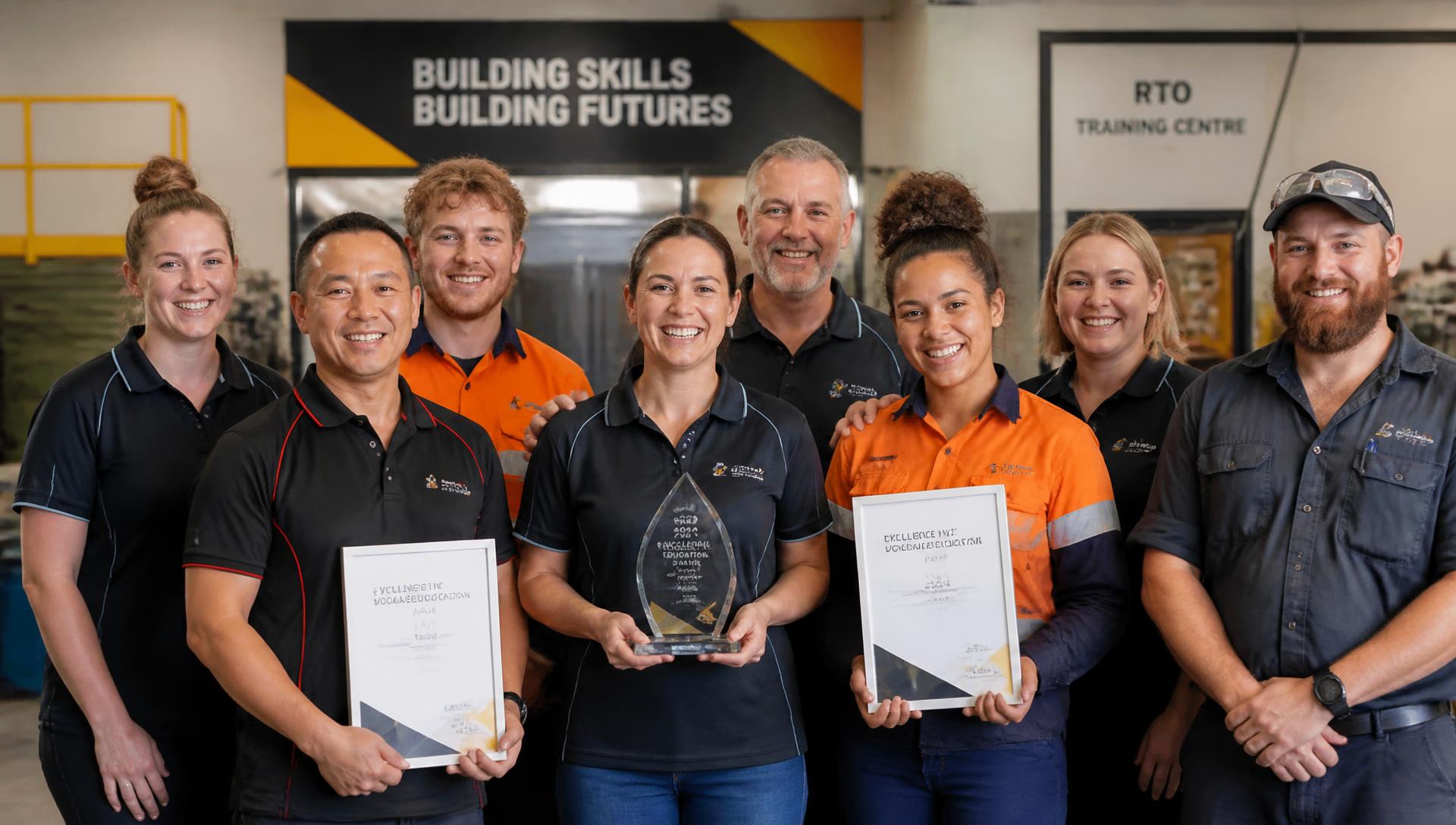
Start with the 2025 Australian Training Awards, because the pattern jumps out immediately. Taylorweir Hairdressing and Barber Training in Western Australia took Gold as both WA and National Small Training Provider of the Year. It is WA's longest-running private RTO at 29 years, and it trains roughly 46% of the state's hairdressing and barbering apprentices.
That is not a broad-based provider hedging its bets across a dozen qualifications. That is one trade, done for nearly three decades, done well enough to become close to the default choice in its state.
FCTA – Building Careers in Adelaide won Gold as National Small Training Provider of the Year with an even narrower proposition: it describes itself as the only provider of nationally recognised training in heritage trade skills in Australia, covering bricklaying, stonemasonry, tiling and heritage restoration. Its students train on live heritage sites through a partnership with the National Trust of South Australia, and it runs a Stonemasonry Scholarship aimed at bringing more women into the trade. There is no larger, better-resourced competitor chasing that market, because there is barely a market to chase — and that is precisely the point.
The pattern holds further down the list:
- LTT Group in Perth, WA's Large Training Provider of the Year, specialises narrowly in laboratory operations and phlebotomy training.
- MTA Training and Employment in South Australia, a not-for-profit, industry-owned RTO, took Gold as SA Large Training Provider of the Year on the strength of an automotive-only focus: more than 1,100 apprentices across nine automotive trades, South Australia's first dedicated EV Training Centre, and the country's first dual vehicle and auto-electrical apprenticeship pathway.
Independent RTO brokerage ANK Corp reads the broader market the same way: "The generalist model is declining. Providers focused on high-demand fields — cybersecurity, allied health, renewable energy, advanced manufacturing — aligned with government skills priorities will prove more resilient." On the evidence of this year's awards list, that is a reasonable conclusion.
The complication: purpose can beat niche, even in broad fields
Here is where the tidy story runs into trouble. ATEC (Adelaide Training & Employment Centre) and PEER were both finalists for SA Large Training Provider of the Year in 2025, and neither one is narrow. Both are not-for-profit, industry-owned RTOs operating across construction, manufacturing and defence training — fields about as broad as vocational training gets.
Brian Rungie, Chair of the Industry Training Providers Association, offered a different explanation for their success entirely: "Profits don't drive these providers — they're driven by purpose. That's what sets them apart." That is a governance story, not a market-positioning story. It suggests that an industry-owned, not-for-profit structure, with governing persons whose incentives are aligned to the industry's workforce needs rather than to shareholder return, can be its own competitive advantage — independent of how tightly the training scope is drawn.
Other 2025 finalists round out a picture that rewards specificity in a different sense: not narrow trades, but tightly targeted communities and problems. The IAHA NT Aboriginal Health Academy won Gold in the Industry Collaboration Award category; a Mobile Skills Lab aged-care collaboration in Victoria took Bronze in the same category. Airservices Australia won Gold for Innovation in VET in the aviation and air traffic services space, and the Australian Nursing and Midwifery Education Centre took Silver in the same category. These are niche in the sense of serving a defined population or industry deeply — which is a related but not identical idea to Taylorweir's or FCTA's single-trade focus.
Check your compliance maturity
Take our free 3-minute check to identify compliance gaps and get actionable recommendations.
The opposite path: winning by going broad
Then there is a strategy that looks like the mirror image of everything above. Lumify Group has grown into Australia's largest corporate ICT and digital-skills training provider not by narrowing its focus, but by acquiring its way to scale: Auldhouse for $16.6 million in 2021, City Desktop Training, and Nexacu for $19.1 million in 2025, taking combined capacity above 30,000 students a year.
Lumify's CEO, Jon Lang, described the Nexacu acquisition as "a perfect union in terms of market adjacency and expansion" — the language of a roll-up, not a specialist. EdventureCo, a private-equity-backed buy-and-build operator, has taken a comparable path to roughly $80 million in revenue.
What both groups share is not narrowness but distance from the government-subsidised system altogether: they sell broad, corporate-facing training portfolios directly to employers, bypassing subsidised training entirely rather than competing for a shrinking share of it.
That last point matters more than it might first appear. NCVER's 2025 figures show total qualification enrolments falling across every provider type — TAFE down 7.1%, private providers down 5.5%, community education down 11% — while stand-alone, non-qualification subject enrolments rose 3% and now account for 71% of all VET activity. NCVER attributes much of that growth to domestic fee-paying students at private providers; domestic fee-for-service short courses alone grew 32.7% in a single year.
Independent commentator Claire Field describes private providers showing "continued strong growth in subject-only enrolments and modest growth in short course enrolments," offsetting their qualification-level declines. The corporate training market feeding this shift was valued at roughly $8.3 billion in 2025 and is projected by market research firm IMARC Group to reach almost $15 billion by 2034. Lumify and EdventureCo are not niche stories. They are evidence that there is more than one way to read where the money and the growth are actually moving.
Two warnings against overconfidence
None of this should be read as a formula, and two examples from this series make that plain. RGIT — the Royal Greenhill Institute of Technology — was broad, international and multi-disciplinary, drawing students from 47 countries. It still collapsed into liquidation.
Southern Academy, trading as the Phytodermal Institute of Beauty, was about as genuinely niche as an RTO gets — a specialist beauty-therapy provider — and it was still cancelled by ASQA over governance and assessment failures, including problems affecting a childcare qualification it also certified. Specialisation did not save it, because the failure was not one of market positioning at all. It was a failure of governance.
The thread worth pulling on
Niche focus, purpose-driven ownership and disciplined scale through acquisition all appear as real, evidence-backed paths to strength in 2025-26. But every one of these providers, whichever strategy they follow, still has to run an operation that can withstand scrutiny: current, mapped assessment evidence; governing persons who can demonstrate oversight rather than assume it; registers, validation cycles and continuous improvement records that hold up when ASQA — or a training award judging panel — comes looking.
No strategy, however well chosen, substitutes for that. And no software can promise a particular audit outcome; what it can do is make the evidence of good governance easier to produce and keep current.
What this means for RTOs choosing their next move
That is the specific, separate problem ComplyHub.ai was built to solve — as a compliance software platform in its own right, distinct from Vivacity's advisory work, for RTOs who have chosen their market and now need the operational discipline to defend it. If you want to see what that looks like for your own provider, ComplyHub.ai offers a 14-day free trial, no credit card required, at complyhub.ai.
FAQs
Sources
- • Australian Training Awards
- • WA Training Awards
- • SA Training Awards
- • National Centre for Vocational Education Research (NCVER)
- • Claire Field & Associates
- • IMARC Group
- • ANK Corp
- • Lumify Group

Angela Connell-Richards
CEO and Founder, ComplyHub and Vivacity
Angela is the CEO and Founder of ComplyHub and Vivacity, with over 20 years of experience in RTO compliance and quality assurance. She's passionate about helping RTOs build sustainable compliance systems.
Build audit-ready evidence without manual collation
No credit card required. Start with a short trial request using your email.